
Sunday, 19 May 2013

#2 Monday 20 May 2013 (Macau)


The end of April, just before the May Day holiday, we spent a weekend in Macau.
This was a very interesting few days. We took a high speed train, that travelled 200 km,
to Macau, which is on the mainland coast to the west of Hong Kong. Our Holiday Inn
hotel was downtown and in walking distance from the old historical section. This was one
of the most interesting places. Finally I was able to know where Macau was. You
probably have heard the name, but where is it?
Look up the history of Macau. It was the base, starting in the 1500's, for the Portuguese
traders. They were able to build a walled city there and it was an important trading centre,
much like Canton (which is Guangzhou). Macau declined in the 1800's after Hong Kong
became British and important as the centre of Western commerce in the Eastern Asia. It has
remained a small city.
Macau has retained a Portuguese flavour with its delicious food, buildings, churches
and cobblestones. The historical centre is very interesting, especially with all the old
Roman Catholic buildings. You can visualize what it meant for commerce and
Christian evangelism. The distinctive cobblestone design makes the city instantly
recognizable.
Today, the place must be the mecca for gambling. Part of the city is like Las Vegas in
China. There are actually casinos that are replicas of the Las Vegas counterparts, but
larger. We walked through the Venetian casino complex and had a gelato in their
St. Mark's Square just so we could say that we had been in St. Mark's on 3 continents.
We had a quick look, but loved the old historical district more. We could tell that people
from all over are drawn to Macau. There were many Westerners, Indians, and others
who were speaking non-Chinese languages.
From our hotel we were told to visit Margaret's Bakery, since we had heard that pastries
are famous in Macau. We found it in a dark little alley. The line-up was 50 deep and apparently
it is like that all day. We sat outside, ate, and it was wonderful. People were buying the egg custard
tarts, by the dozens, and so we did too. We went back the next morning!
Monday 20 May 2013

Don says that it is almost impossible to describe. To me it sounds like a cow is caught
in something and is mooing, but is getting tired. The sound is loud and can be heard
through the apartment's thick, cement walls even with the AC and TV on. It is not the
chirping cicada noise that we heard last fall. This sound comes with spring and summer nights.
Discussing this with Susan Hertz, another BYU teacher, we wondered if we were hearing
someone from another apartment snore. It has been a mystery. Finally, last week I was
walking home and it was dark. A female student was standing on the sidewalk, under a tree,
listening to the racket. I stopped and she was able to speak English very well.
ME: What is that noise?
STUDENT: Frogs.
ME: Are you sure?
STUDENT: Yes, frogs.
ME: How big are they?
STUDENT; About this big. (the showed me a size like the flat of her palm)
So, the mystery is solved.
It is almost unbelievable that little frogs could have this volume of noise.
To tell the truth, we will miss it.
Sunday, 12 May 2013
Monday 13 May 2013

Michael is from the neighbouring province of Hunan and is a sociable, enjoyable and decent young man.
Every Friday he visits a married sister who lives in the city. He cooks a meal for her and helps out, since she is expecting.
This is a typical example of Chinese kindness within a family.
One day he told us that he has three older sisters. This is his story.
"My family has four children, which is unusual. Every family is supposed to have one child, but my father
was able to pay the fine and so we can have more children in our family. It is a very large fine, amounting
to thousands of dollars. My father is not rich, but he was able to pay the fine. My parents love me the most.
For example, I will be given the best piece of meat to eat. It will be put on my plate."
When Michael said this, I had to question him about being loved the most. Do you mean that you are loved because
the family finally has a boy, but everyone is loved equally? Michael replied, "No, I am loved more." This was not said
in an arrogant or unkind way. It was just a matter-of-fact reply. We talked about how girls must feel. He said that
families also love the daughters, but that sons are loved more. He also said that he will not feel like this when
he becomes a father. He will love a boy or a girl equally.
This one-child policy always comes as a shock to Westerners, even though we may understand the practical motivation for its inception.
From my conversations and perceptions, most Chinese do not like this policy, even though they support it as having been necessary.
Most believe that the policy will not be in effect for much longer. That could mean decades still, I suppose. As I listen to student
presentations, I learn that most students come from one-child families. But, many have another sibling, and a few even have more than one.
The pattern is usually the same as Michael's, which is a number of girls and a boy as the youngest. My assumption is that the family
has the means to pay the fine and is not dependent on a government job.
There are exceptions to the one-child policy. Here are a few that I know of.
If both parents come from a one-child home, they may have two children.
Minorities are exempt in certain ways.
A government job limits parents to one child.
Rural parents have some flexibility .
This is a sensitive topic for China. However, my students have been open and eager to discuss it.
Very often they will ask if I know about the one-child policy in China.
I think that they are wondering how it is perceived beyond China. One older student, who is a father
to a little boy, said, "My little boy is lonely. I wish we had another child for him to play with."
Also, the one-child policy has caused a surplus of boys, amounting to millions.
There is even social concern about boys not finding wives to marry.
Right now it is good to be a young, single woman in China. It has not always
been good to be a female in China. On Friday, a student gave a presentation
and said that his mother had to quit school at age fifteen to help pay for her
brother's college tuition. China has made great strides with gender equality. The
president of our university is a woman. However, there is still a long way to go.
One reason I like the new President Xi is because he has one child and she is a daughter.
Michael claims that gender identity before birth is illegal, but it must happen. With such a strong
cultural preference for male children, I respect all parents who happily
love their little girl.
Sunday, 5 May 2013
Monday 6 May 2013
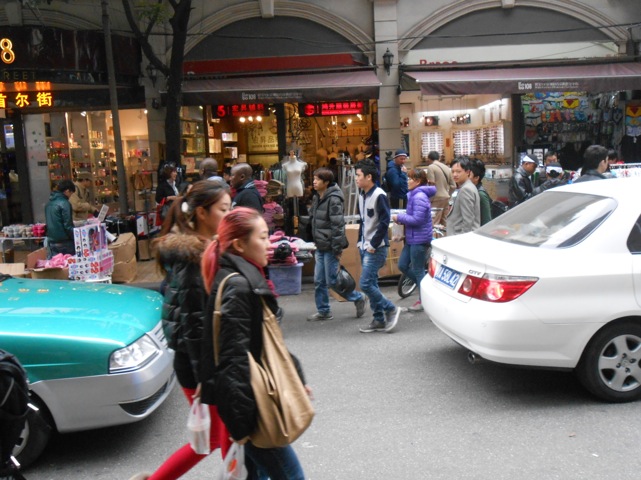


There must the thousands of them, even tens of thousands. You
can usually spot a taxi cab wherever or whenever you look. In Guangzhou
the usual colour is green.
We rarely take a taxi, except on Sundays when we take one to the
Ramada Pearl Hotel for church. Other times we use the bus or metro
systems. There is one card that is used as payment for both
on systems. The card is refilled at Seven Eleven stores.
All taxis are metered and the cost is minimal. The flat rate is 10 yuan, which
is about $1.75. Most fares range from 20 yuan to 30. Our visitors wondered why
we don't use them more often.
Don has become good at telling where we need to go, when it is our campus, in Chinese.
He has even been complimented on his Chinese. Taxi drivers almost never look at
him with a blank stare, anymore.
We have been scammed only twice.
One time, on a Friday evening, a driver took us the long way home, not realizing that we
actually knew how to get home. Don questioned him, and he is able to hold his own
in a Cantonese "discussion." After all, it was costing us 45 yuan.
The Big Scam happened during the Spring Festival (Chinese New Year).
We had just returned from our visit to Hong Kong with Ian, Debby, Matt and Lily. The line up at
the taxi stand, in front of the East Guangzhou Railroad Station, was lengthy, to say the least. The
buses at the nearby bus terminal had stopped for the night. We wanted to take a taxi and looked around
for an alternative to the taxi stand line up. We spotted two lone taxi cabs off on a street to the left.
They asked for a set rate, which should have been our first red flag. But it was late.
With six of us, we took two cabs. I was with Ian and Debby, sitting in the front seat.
On the way home it soon became obvious that we were lost. Nothing looked familiar, and then the
driver took out his cell phone and we were certain what the conversation was about. (Matt was in the second cab, and
he could see that the dark, narrow roads were not the usual for a taxi). Luckily, I spotted what I thought was the
back entrance to our campus and directed our cab to take a right turn. It was the correct road.
When we got out and paid, the driver made a scene of saying, "This money no good, no good. " We handed him another
100 yuan bill and the same thing was said. Ian came to the rescue and said, "The money is good, we've been using
it all day." He grabbed the bags, slammed the door and we went in.
As it happened, the same scenario was played out when Don's cab arrived. "No good, no good." Also, the doors were locked
so no one could leave the cab until the payment was satisfactory. As it turned out, in the confusion, some counterfeit bills
were exchanged. Don got the counterfeits and the taxi driver kept the good bills. We weren't aware of the switch until the
next day when Don tried to use his 100 yuan bill. The store clerks check every 100 bill, and sure enough, it was not a good one.
Then everything fell into place.
This Big Scam was our own fault.
Almost all taxi rides are a good experience, except for the darting in and out, and the seeming lack of traffic rules.
We always stand in the official taxi stand line now.
Once we stood for an hour, but it is worth it.
One photo is of a busy street, and the taxi front can be seen…..green.
The second is of Don waiting at a bus stop. (He is often carrying my purse)
The third picture is a random look at some lovely water plants. (From the Botanical Garden)
Friday, 3 May 2013
Saturday 4 May 2013


This is probably because it is fresh, here in the south of China, with farmers bringing local crops to market.
The fruit is often sold off trucks parked on streets, and at small sidewalk markets. In other words, there is no
middleman or warehouse storage. It is fresh.
Last autumn, Don and I noticed how wonderful the oranges tasted. It was the season for mandarin oranges and
tangerines, and it was 'Christmas' all fall. It is impossible to describe how great these oranges were, in taste, in texture and
in sweetness. They set the standard for perfect oranges.
Then the fruit kept coming, with equal rave reviews.
Bananas, grapes, apples (which may not be local since they are individually wrapped), mangos, watermelon.
For the past few months, pineapples have been in season. They are small and sweet and the best we have ever tasted.
Even Don, who spent two years in Hawaii on his mission, says that these are number one. And, how many of you have
experienced a real, fresh, soft, perfect mango? OK, the fellows who lived in the Philippines have. It is mango season now.
Eat your heart out!
There are types of fruit that we have never heard of.
One is the durian. It is a large, oval, interesting, spiny tropical fruit.
We first noticed it when we walked past a stall that emitted a terrible, revolting odor.
I looked up the fruit in the dictionary to see if I could explain it properly. The description said that
durian has a 'fetid smell', and 'fetid' means 'smelling extremely unpleasant.' When Ian and Debby
were visiting, Debby exclaimed, "What is that?" It was that fetid smell coming from a durian
stand. The odor rivals anything in China, even the sewer-fume manholes.
The taste must be better than the odor, since people buy it and you see durian flavoured ice cream.
Once (Uncle) Ian and I were buying gelato at a good ice cream stand. We asked what the favourite
flavours were and the girl replied, "Chocolate, mango and durian." Since Ian could hardly believe
that durian was in the top three, he had a sample. Then he really couldn't believe it!
I goes to show that some things are an acquired taste.
One photo is of durian.
Another photo shows a fruit stand and a sweet little boy.
The last two are of our alley, behind the campus. Don goes there because he likes to "buy local." It is 2 minutes from our apartment.
Our gate is at the trees at the end of the alley, which we have named 'Dumpling Alley,' because of a good dumpling shop.
The shop is always busy, usually with students from the north, who especially miss their dumplings. Dumplings are like wan tons.
No one was up this Saturday morning, but the street is usually busy. You can see a lady carving a pineapple.
Thursday, 2 May 2013
Friday 3 May 2013

China officially has 1,354,040,000 people, making it the most populated country with 19.2% of the world's population.
In comparison, the United States has 4.46% and Canada has .49%. We are next to Uganda on the population list.
This was a concern to me, since most would know that I like/need my personal space and never go where crowds are.
I can report, that it has been manageable.
To be truthful about it, the overwhelming number was a shock and something that had to be adapted to.
Instead of hundreds on a crowded shopping street, there can be tens of thousands. It can be daunting to just walk
down a narrow street in some parts of the city. Since we are living in a city with a population of 20 to 30 million, the force
of the numbers is more apparent than in a smaller city. (Yes, the population spread is because the numbers are merely a guess
since many migrants come to work in warm and busy Guangzhou.)
China has a vast countryside and wilderness where the experience would be completely different.
But here in Guangzhou, having people everywhere all the time is a fact of life.
The Chinese seem to manage this very well. The metro (subway) is a good illustration. At peak hours, there are
literally a few million people using the system and the subway cars are crowded to capacity. Standing room only.
You are swept along with the tide. The most interesting thing is that you are never touched, or almost never. Everyone simply
moves along without elbows, or shoving, or pushing. There is not only physical distance and politeness. I have never
heard an impatient word in the metro. This is amazing because, budging in line is standard even though
the metro security attendants try to keep order with metal fences, gates and blow horns. Everyone moves with surprising
tolerance, and it works. It is probably obvious that a stampede would be a disaster. Plus, the Chinese culture is naturally
very polite and patient.
To my way of assessing the huge population, the Chinese have the ability to isolate themselves when in a crowd, which is most of the time.
You see behaviour that would appear odd in Canada. People practicing tai chi is one. Another common sight is someone talking
loudly on a cell phone, as if no one is around. This happens in Canada, but in China it is much louder and without any social
inhibitions at all. People are in an isolated, little world and this is necessary in a city where there is very little
private space. They are able to create their own private spaces wherever they are.
By the way, Cantonese speakers, who are the majority in our city, have an animated and loud conversation style.
It reminds me of listening to Italian speakers. You wonder, "Are they having an argument?" They aren't!
This is a stereotype, but will ring true to those of us who have grown up with Chinese friends at school and in our little, prairie communities.
Most were Cantonese speakers.
Subscribe to:
Posts (Atom)